



CONCRETING
WORKS
CONCRETING
Concreting requires specific knowledge, precision, and diligence, as the quality of concreting affects subsequent construction or finishing stages, such as floor installation. At “Heko,” we can carry out concreting works of various complexity – from foundations to wall concreting.
Since we implement construction projects from the very beginning, we understand the importance of every stage, including concreting. By choosing “Heko” for concreting works, you can be sure – we will select the right materials, use top-quality equipment, and ensure this construction stage is executed properly.
Concrete is one of the most widely used construction materials. It is versatile, durable, strong, and fire-resistant. Because of these properties, it is often used in construction and engineering – from building construction to complex engineering structures: concrete is used for foundations, walls, slabs, stairs; bridges, overpasses, road surfaces, etc. Depending on its purpose and environmental conditions, different types of concrete are used.
We carefully assess the situation, choose the right type of concrete, and carry out concreting works thoroughly. We work responsibly, promptly, and adhere to the highest quality standards – our clients can attest to this.
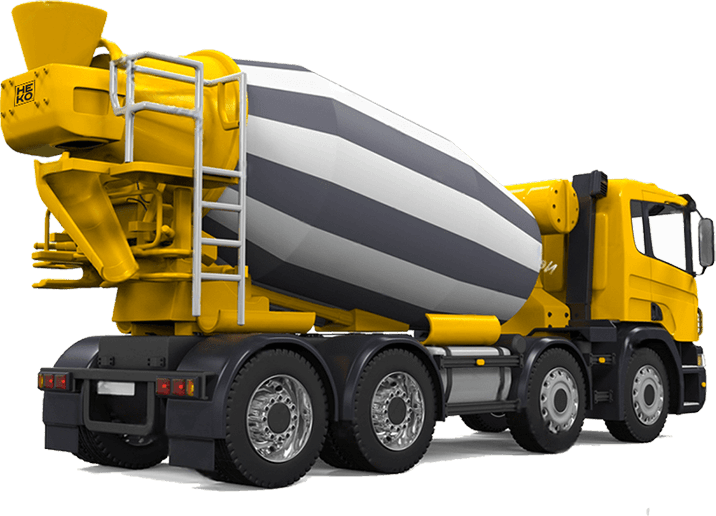
CONCRETING PROCESS
Concreting is a process that requires specific knowledge and must be done with great care to ensure the durability and longevity of the structure.
Proper execution of concreting can determine the success of subsequent construction and finishing stages – concrete is used to build foundations, floors are laid on it, etc. That is why concreting must be done correctly – including preparation, a smooth process, and protecting the concrete while it dries.
Concreting is a multi-stage process during which a liquid concrete mix becomes a solid, strong, and long-lasting material. Naturally, the concreting process and its stages depend on the specific work – whether it’s pouring foundations, floors, or other structures.
Concreting begins with preparation: selecting the formwork system, checking the base, preparing reinforcement if needed. During the preparatory stage, the appropriate type of concrete is also selected depending on what is being concreted.
When concrete is poured into the prepared mold, it is essential that it spreads evenly, leaving no empty spaces or air pockets. The concrete mix may be compacted using special equipment. In general, proper equipment must be used for concreting – only by entrusting this work to professionals can you ensure durability.
Another critical stage of concreting is drying. This takes time and requires the right conditions. It is vital that the concrete does not dry too quickly – this could compromise its durability. Concrete should also be protected from cold and excessive heat. To ensure proper curing, concrete is often watered or covered – to prevent moisture from evaporating too quickly.
CONCRETE
Concrete is one of the most commonly used construction materials for many reasons.
Concrete is chosen for foundations, walls, and used as a base for floors and stairs; it is suitable for both interior and exterior structures, as well as for road and bridge construction. Concrete manufacturing and pouring technologies are well-developed and enable efficient and timely construction – though they require specific expertise.
Key advantages of concrete
- Concrete has high compressive strength – it is categorized into different classes based on this, and the appropriate class is selected depending on its intended use.
- Properly executed concreting ensures that concrete maintains its integrity over time.
- Concrete is fire-resistant (it retains its properties even at 1000°C), and is resistant to temperature changes and moisture, making it suitable for both interior and exterior structures.
- Insulating properties. Concrete provides excellent insulation, such as effective soundproofing.
- It adapts to each project and allows for the formation of necessary structures.
Concrete can also be combined with other materials (steel, glass, stone, wood) to create structures of varying strength and aesthetics. It is increasingly used as a finishing material, with exposed concrete surfaces, especially in commercial buildings. These features make concrete an irreplaceable material in both small- and large-scale construction projects.
CONCRETING FOUNDATIONS, FLOORS, WALLS, STAIRS
Although concreting may seem simple at first glance, successful execution requires precision, knowledge, and attention to every step.
Due to its strength and durability, concrete is chosen as a material for foundation structures, flooring bases, etc., making proper implementation of the concreting process very important.
Foundation Concreting
Foundation concreting is one of the most critical and initial stages of building construction. Properly prepared foundations ensure building stability and safety. The preparatory phase is vital – including detailed site analysis and geological surveys.
Next comes digging foundation trenches and installing formwork and reinforcement, which is used to strengthen the structure. When pouring foundation concrete, it is important to distribute it evenly and ensure density – special equipment is used for this. Properly executed foundation concreting provides a strong base for the entire building.
Why is concrete chosen for foundations? Firstly, concrete is an extremely strong material – it can withstand heavy loads, is fire-resistant, and durable in various environmental conditions. Another advantage is its versatility and flexibility – different types of foundations can be formed with a concrete mix.
Floor Concreting
Floor concreting is used to form a strong and level base. The concrete layer ensures proper load distribution and mechanical resistance. Floor concreting is done after installing the necessary engineering systems (electrical, heating, etc.). Concrete also contributes to thermal and sound insulation.
Floor concreting is done not only for technical reasons – concrete also supports floor aesthetics. It serves as a base for parquet, laminate, PVC coverings, tiles. A properly concreted surface ensures floor smoothness and helps avoid cracks, deformations, etc. In industrial premises, concrete is sometimes used as the final floor layer.
As with foundation concreting, it is crucial to ensure optimal conditions for concrete curing – concrete that dries too quickly may result in a weak floor base.
Wall Concreting
We carry out concreting of load-bearing, monolithic, and other types of walls. Wall concreting is commonly used in the construction of apartment buildings, industrial, commercial, and engineering structures that require high strength and structural integrity. Retaining walls are also very important – they are concreted for underground parking, slope stabilization, terraced plots, etc.
Concrete walls are also used for aesthetic purposes to create unique designs. One of the main advantages of concrete walls, besides strength and durability, is the ability to form custom shapes. Concrete walls have excellent insulation and moisture resistance, making them suitable for basement construction.
Stair Concreting
Stair concreting is a popular choice for both residential and commercial or industrial buildings. Concrete stairs are strong, load-resistant, and durable, often chosen over wooden or metal alternatives.
Stair concreting is also used as a design element, as it allows various shapes to be formed to fit specific project needs. Concrete can serve as a base for stair finishes (tiles, wood, etc.) or as the final finishing layer. Concrete stairs are a safe and long-lasting solution for many types of buildings.
ECOLOGY
Sustainability is one of our core priorities. We recognize that the construction and engineering sectors can have a significant environmental impact. That is why we are committed to minimizing our ecological footprint by implementing sustainable, environmentally responsible solutions and promoting the efficient and responsible use of resources.